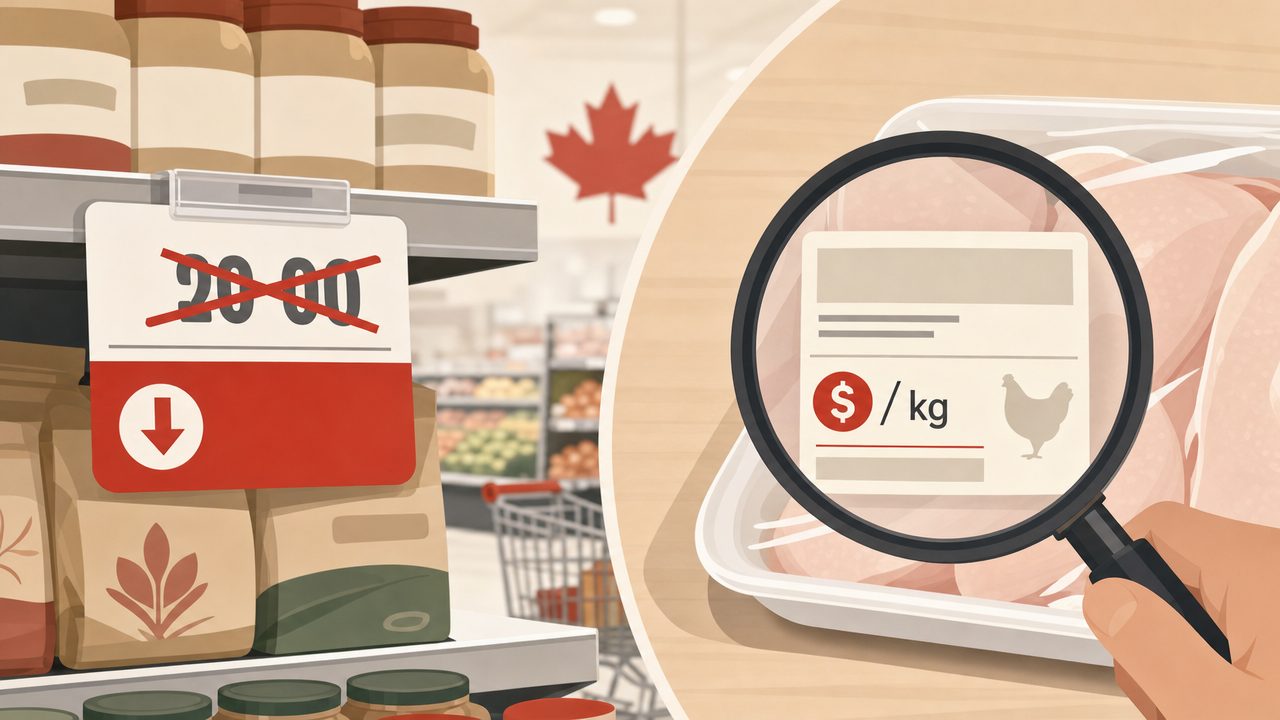
Next time a flyer says “regular price $4.95, on sale for $3.47 — save 30%”, ask yourself: does anyone actually pay $4.95 for this?
We asked ourselves the same question. So we did something no one else in Canada is doing: we scanned 56,860 shelf prices across 10 banners (IGA, Maxi, Metro, Super C, Walmart, Giant Tiger, Avril, Mayrand, Supermarché PA, M&M) and compared them against the prices advertised in this week’s flyers.
The results are a little awkward for the industry.
What we did
Every week, we record the prices printed on actual store shelf tags — not flyer prices, the real ones you see when you walk down the aisle. This week: 56,860 products, most recently updated between August 14 and 16.
Then we took the 689 deals this week (W33) that advertised a “regular price” anchor, and looked for the same product in our shelf records.
53 products matched exactly — same name, same format. Of those 53:
- 38 (72%) advertised a regular price HIGHER than the real shelf price.
- The other 15 were accurate or even understated.
⚠️ Honest caveat: this is a sample, not a census. Most flyer names don’t match shelf names 1:1, so we compared what was comparable. But the trend is clear and consistent.
The cleanest case: Pearl Milling syrup
The cleanest product to compare this week: Pearl Milling Company Original Syrup, 710 ml, at Giant Tiger.
- GT flyer: “regular $4.95, on sale $3.47 — save 30%“
- Walmart shelf (same product, same size): $3.97 — with its own “was $4.47” tag
- Giant Tiger shelf: $4.25
So the real “regular price” on the market is $3.97 to $4.25. The actual discount: 13 to 18%, not 30%. The $4.95 is an anchor price, not a real one.
Produce: the gaps get even bigger
In fresh produce, the gaps get dramatic (caveat: formats vary — bag vs unit):
| Product | Claimed “regular” | Shelf price |
|---|---|---|
| Limes — Super C | $4.99 | $1.97–2.00 |
| Raspberries — Super C | $4.99 | $2.00 |
| Raspberries — Metro | $4.99 | $2.00 |
| Cantaloupe — IGA | $4.99 | $1.93–4.27 |
A flyer advertising “61% off” limes “regularly $4.99” — when the real shelf price is $2 — is a real saving of 1%, not 61%.
Meanwhile, packages are shrinking
The “regular price” isn’t the only thing to check. Our shrinkflation tracker compares package sizes over time (price per kg/L, not per package). As of today: 29 verified events — several recent ones:
| Product | Before | After | Cut |
|---|---|---|---|
| Jell-O jelly powder | 128 g | 85 g | -34% (national, 5 banners) |
| Filippo Berio olive oil | 750 ml | 500 ml | -33% |
| Fibre 1 bars | 175 g | 125 g | -29% |
| Quaker Croque Nature cereal | 650 g | 510 g | -22% (national) |
| Saputo shredded mozzarella | 400 g | 320 g | -20% |
A smaller package for the same price is a disguised price increase. Shrinkflation is inflation in hiding.
What this means for you
- Watch the price per kg or per L, not the package price. It’s the only honest number.
- Treat the flyer’s “regular price” as an anchor, not a fact. The real price is the one on the shelf.
- Compare flyers across stores before making your list. The same product is often on sale at two or three banners the same week.
That’s exactly why Circulaires Québec exists: we pull this week’s prices, put them side by side, and show the unit price for every product. No invented anchor prices — the real price, for real.
👉 See this week’s deals — compared across all banners, with the true per-kg price.
Methodology: shelf price scans collected August 14–16, 2026 across 10 banners (56,860 products). Compared against week 2026-W33 flyer deals advertising a regular price (689), matched by exact name (53). An “inflated regular price” = advertised price higher than the scanned shelf price for the same product. Shrinkflation data comes from Circulaires Québec’s package-size tracker (29 verified events, formats compared over 30 weeks).